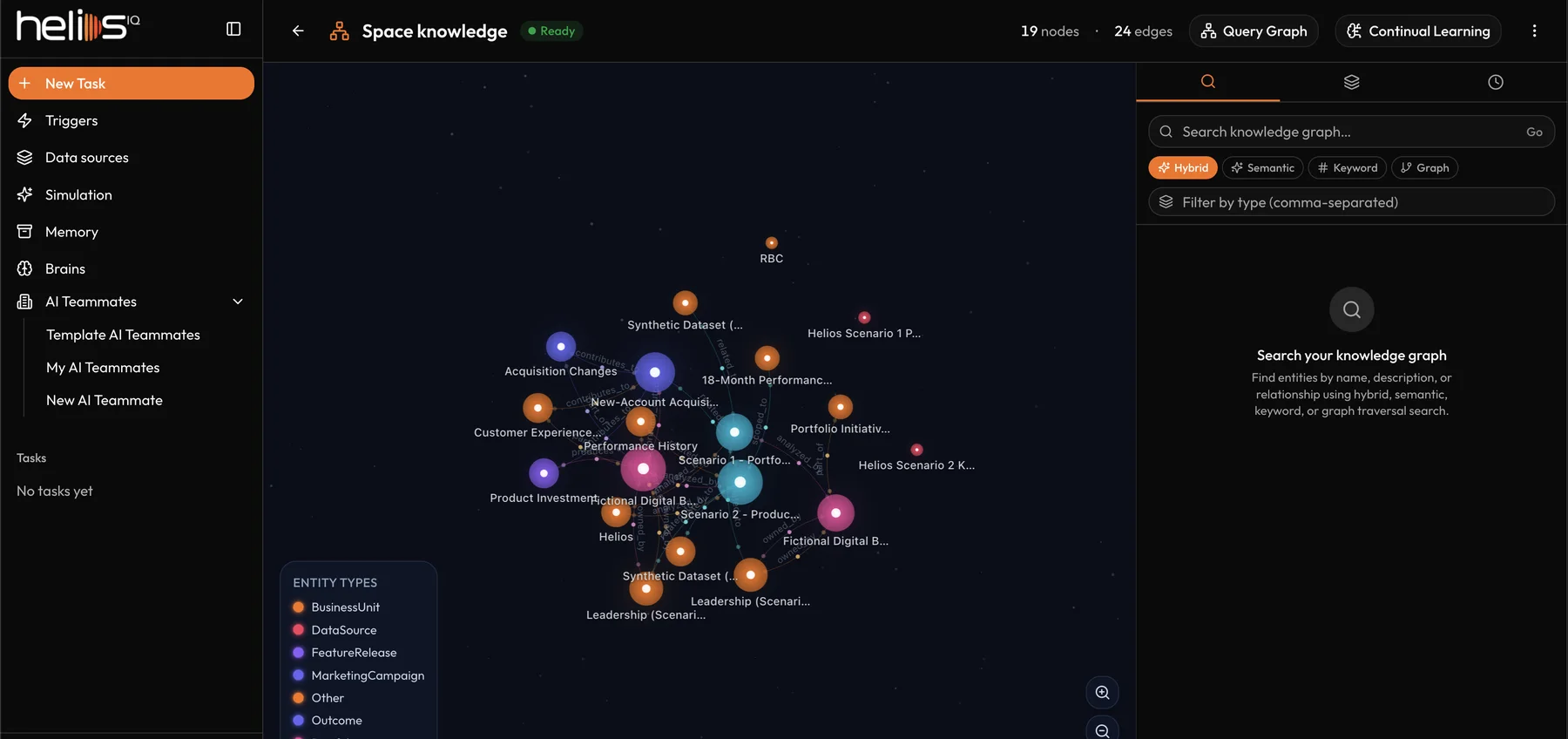
Helios World connects entities, relationships, facts and events into a versioned operational state, with provenance, permissions and controlled updates. Your applications and agents work from a common foundation, while every change remains attributable and inspectable.
Helios World · example
You askCan we fulfil this order, and what needs to happen next?
on hand120 units in the warehouse.
reserved30 units held by existing orders.
available90 units. New order needs 80.
agent aReservation committed. Available: 10.
agent bNot committed. State has changed.
Your organisation changes between every conversation.
A customer changes an order.
A warehouse reserves stock.
A contract amendment introduces a new obligation.
An agent prepares a delivery plan using information retrieved ten minutes earlier.
Each system may hold a different part of the picture. Before the next decision, you need to know what currently applies, where it came from and whether it has changed.
World makes that state explicit.
Watch separate records become one operational picture.
You ask:
Made-up task · example
Can we fulfil this order, and what needs to happen next?
A customer orders 80 units of a product.
The order appears in your CRM. Inventory lives in your ERP. Delivery requirements appear in a signed contract.
01Connect the entities
World represents the relevant business objects and their relationships.
Entities · example
Entity
Connected information
Customer
Identity, accounts and contractual relationships
Order
Customer, product, quantity and status
Product
Inventory records and fulfilment requirements
Warehouse
Stock, reservations and location
Contract
Parties, obligations and effective versions
Delivery
Order, destination and planned milestones
Source records remain traceable.
Potential matches between entities are evaluated under configured identity rules. Ambiguous matches require resolution before records are merged.
An illustration with made-up records. No system is connected, nothing is read or sent, and no AI model is called.
Model the things that matter to your organisation.
Define typed entities such as customers, assets, products, projects, contracts and facilities.
Describe their relationships:
Owned by
An asset and the organisation responsible for it.
Located at
Stock and the facility that holds it.
Depends on
A project and the work it waits for.
Requires
An order and the product it needs.
Supplies
A supplier and the products it provides.
Authorises
A contract and the actions it permits.
Attach schemas and domain constraints to the model. Required fields, valid types and relationship cardinalities help keep updates structurally consistent.
Changes to the model are versioned, with explicit migration and compatibility handling.
Facts carry more than values.
A fact can include:
Anatomy of a fact · example
Attribute
Purpose
Value and unit
Preserve meaning in calculations
Source
Identify the originating record or assertion
Valid time
Record when the fact applies in the domain
Recorded time
Record when the system learned it
Status
Distinguish proposed, accepted and superseded information
Confidence or uncertainty
Represent limitations where appropriate
Authority
Identify who asserted or approved it
Access policy
Control who may retrieve or change it
An extracted statement, an inferred relationship and an approved operational fact retain their distinct status.
Ask what was true, and what was known.
A supplier reports on Friday that a shipment left on Wednesday.
World can represent both dates:
Two timelines · example
Valid time: Wednesday.
Recorded time: Friday.
This supports different questions:
What is the latest recorded account of Wednesday's events?
What information was available to us on Thursday?
Corrections preserve the history needed to reconstruct earlier decisions, subject to retention policy.
Keep disagreement visible.
Two sources report different delivery dates.
World retains the competing assertions and applies configured source-authority and resolution rules.
Where no authorised resolution exists:
Conflicting information · example
Delivery date requires review.
Missing, stale and disputed information remain distinguishable from accepted current state.
Give each agent an authorised view.
Permissions apply to entities, facts, relationships and operations.
A delivery agent may access shipment requirements without receiving commercial margins. A finance agent may access payment terms without receiving unrelated employee information.
Graph queries, search results and subscriptions respect the authorised view.
Tenant boundaries and explicit sharing policies govern cross-organisation access.
Create snapshots for decisions and experiments.
Capture a versioned snapshot of the relevant world. Use it to:
Evaluate a proposed action.
Reproduce the context behind a decision.
Compare two versions of the state.
Initialise an isolated simulation.
Inspect the changes between planning and execution.
A simulation branch remains separate from operational state. Applying a proposed change requires a new authorised operation.
Connect the world to action.
World provides the shared entities, state references and version history connecting these operations.
Know what exists. Track what changes. Give every agent a common ground.
Indicative case study
One connected picture.
People, systems and decisions shown with how they connect.
A screen from the Helios platform, shown as an indication. Names removed. Not a customer result.
Helios platform screen
Pricing · Proposed launch prices
Start at €149 a month. Grow when the work does.
Choose the capacity and controls your work needs. Prices below are proposed launch prices. Join early access without payment; supported capabilities and integrations are confirmed before activation.
Which describes you?
BuilderTeamBusinessEnterprise
About 200,000 customers tracked with their orders and contracts.
What is an active record?One record is one thing your business keeps track of: a customer, a contract, a shipment, or a link between them. A company with 20,000 customers, 80,000 orders and their relationships sits well inside 1M records.
For a team, Ori suggests Team. 10× Builder’s records for 5.4× the price.
Start
Builder
Model one operational domain.
€149/ month
No payment to join early access.
100Kactive records
About 20,000 customers tracked with their orders and contracts.
1World
1admin
7day history
Includes
Email support
Then €2 per 10,000 additional standard reads and €3 per 10,000 record mutations.
Everything included
1 production World and its test environment; 1 administrator.
100,000 active state records within 5 GB of persisted data.
50,000 standard read units and 25,000 record-mutation units per month.
Typed entities, relationships and facts with source references.
Schema validation and supported mandatory invariants.
Separate valid-time and recorded-time metadata.
Competing assertions retained with explicit resolution status.
Scoped read and write credentials.
Controlled updates with version checks inside the supported transaction boundary.
Snapshots and 7-day historical-state retention.
7-day operational audit history, exports and usage alerts.
Managed European hosting and email support.
Additional usage: €2 per 10,000 additional standard reads and €3 per 10,000 record mutations; capacity expansions below.
ShareOri's pick for a team
Team
Share trusted state across connected applications.
€799/ month
10× Builder’s records for 5.4× the price.
1Mactive records
About 200,000 customers tracked with their orders and contracts.
5Worlds
5admins
30day history
Everything in Builder, plus
Priority email support
Then €1.50 per 10,000 additional standard reads and €2 per 10,000 mutations.
Everything included
Everything in Builder, with 5 production Worlds and 5 administrators.
1 million active records within 25 GB of persisted data.
500,000 standard read units and 250,000 mutations per month.
Role-based views across entities, facts and relationships.
Configured source-authority and conflict-review workflows.
Versioned schema changes with reviewed migration plans.
Supported change subscriptions and webhook delivery.
Snapshots for downstream decisions and isolated experiments.
30-day historical-state retention and 30-day operational audit.
Project consumption budgets and priority email support.
One onboarding workshop for an agreed source mapping.
Additional usage: €1.50 per 10,000 additional standard reads and €2 per 10,000 mutations.
Govern
Business
Govern operational state across departments.
€2,990/ month
5× Team’s records for 3.7× the price.
5Mactive records
About 1M customers tracked with their orders and contracts.
20Worlds
15admins
90day history
Everything in Team, plus
SSO via supported integrations
Then €1 per 10,000 additional standard reads and €1.50 per 10,000 mutations.
Everything included
Everything in Team, with 20 production Worlds and 15 administrators.
5 million active records within 100 GB of persisted data.
2 million standard read units and 1 million mutations per month.
Department and role-specific authorised views.
SSO through supported integrations.
Configured freshness requirements and stale-state flags.
Explicit review of ambiguous identity merges and conflicting assertions.
Versioned model migrations and controlled production promotion.
90-day historical-state retention and 90-day audit.
Supported audit streaming and guided rollout.
Two domain-configuration workshops and business-hours priority support.
Additional usage: €1 per 10,000 additional standard reads and €1.50 per 10,000 mutations.
Agree
Enterprise
Operational state with agreed performance and service commitments.
From€72,000/ year
≈ €6,000 a month, agreed yearly.
20Mactive records
About 4M customers tracked with their orders and contracts.
50Worlds
30admins
365day history
In this plan
Agreed service commitments
Named technical contact
Then €0.75 per 10,000 standard reads and €1 per 10,000 mutations.
Everything included
Base agreement includes 50 production Worlds and 30 administrators.
20 million active records within 500 GB of persisted data.
10 million standard read units and 5 million mutations per month.
Managed EU deployment; high-availability topology specified in the order form.
365-day historical-state retention and audit in the base agreement.
Named technical contact, security review and migration planning.
Representative-workload sizing and agreed performance acceptance criteria.
Documented transaction boundary and recovery behaviour.
Contractual availability, support hours and response commitments.
Quarterly capacity and data-quality review.
Dedicated, BYOC and longer-history deployments separately quoted.
Additional usage: Base rates: €0.75 per 10,000 standard reads and €1 per 10,000 mutations; workloads beyond the agreed envelope require capacity review.
Starts in Builder
Competing assertions retained with explicit resolution status
Scoped read and write credentials
Make it yours.
Add capacity and integrations when you need them. Nothing here is required to start.
Capacity
State Capacity Pack
€199/ month per pack
Adds 2 million active state records and 50 GB persisted storage; both caps apply.
The details
Adds capacity only. Read and mutation usage retains the base-plan rate. Historical versions consume stored bytes but are not counted again as active current records.
Proposed launch add-on for all paid plans.
Integration
Operational Source Connector
€299/ month per connector
One source-system instance and agreed synchronisation scope, health monitoring and 100,000 additional mutation units per month.
The details
Custom development, historical migration and writeback integrations separately scoped. A source refresh consumes actual record mutations rather than a fee per unchanged record.
Proposed extension; supported adapters and source-permission behaviour confirmed before activation.
Capacity
Extended History Pack
€249/ month per World
Extends historical-state availability to 365 days for one World, with 100 GB additional history storage.
The details
Available from Team. This is queryable history, not an immutable-backup or regulatory-retention certification. Extra storage uses agreed capacity packs.
Proposed launch add-on after retention and restore validation.
Your setup
Team
€799 / monthAn estimate before usage beyond your allowance, setup work and VAT. No payment to join early access.
What you would pay
Team connecting two applications for 50 operational staffUp to five administrators; usage and capacity remain within Team. Staff reading through the applications are not individually licensed.
€799/month
Business with two operational source connectors€2,990 + 2 × €299; connectors add 200,000 mutation units. Inference, source-system licences and custom writeback work excluded.
€3,588/month plus agreed connector setup
Builder with one State Capacity PackAllows 2.1 million active records within 55 GB. The pack increases capacity, not query performance or monthly usage.
€348/month
How usage works
A state record is one customer-visible entity identity, fact, relationship or business event. Internal indexes, embedding fragments and system-generated implementation records are excluded from the active-record counter.
One mutation unit creates, updates or deletes one customer-visible record. A batch changing 100 records consumes 100 units. Retries carrying the same accepted idempotency key must not double charge the same accepted mutation.
A standard read returns at most 1,000 records or 256 KiB of encoded results, whichever limit is reached first, within a two-second execution budget. Additional result windows count as additional reads. Larger exports or analytical traversals need an explicit job estimate. These are proposed admission limits subject to activation testing, not latency guarantees.
Persisted storage includes current records, retained historical versions and snapshots. Historical retention does not guarantee that every external source can be reconstructed; the recorded evidence and source coverage define what is available.
World only enforces an atomic update across data inside its agreed transactional boundary. External-system writes, compensation and cross-system recovery need an integration design or Runtime; no tier changes this mathematical boundary.
Included quotas are shared across the workspace’s Worlds, reset monthly and do not roll over. Hard caps stop new billable work without deleting retained records. Source-export and deletion rules remain available under the agreement.
Model-assisted extraction and entity matching consume customer-key inference separately. Documents ingestion, Simulation runs, Proof jobs and Runtime execution are not silently bundled. Small internal graphs required by those products do not trigger a separate World licence.
Trial proposal: 14 days, one World, 10,000 records, 5,000 reads and 2,500 mutations. All paid prices exclude VAT.
Prices exclude VAT. Monthly plans renew monthly; annual plans require an annual agreement. Provider inference, hardware, specialist licences and services are separate unless explicitly included. No payment is taken for joining early access.
Questions, answered.
Is it available today?
Helios World is in early access. Leave your email and we will write to you when access opens. No payment is taken.
Does World replace our CRM or ERP?
No. Source records remain in their systems and stay traceable. World connects them into one versioned state. External systems remain subject to their own integration and transaction boundaries.
What happens when two sources disagree?
World keeps the competing assertions and applies the source-authority and resolution rules you configure. Where no authorised resolution exists, the value is marked for review.
Can every agent see everything?
No. Permissions apply to entities, facts, relationships and operations. Queries, search results and subscriptions respect the authorised view.
What does the example on this page show?
A made-up order. The quantities, reservations and events are illustrations. No system is connected and no AI model is called.
Does World replace our ERP or CRM?
No. It represents selected source-linked operational state. Records remain traceable to their origin, and the relevant external systems retain their own authority and transactional limits.
Can all agents update the same records safely?
Only authorised operations are accepted, with supported version and invariant checks. Safety depends on the configured transaction boundary and source synchronisation; it is not a blanket cross-system guarantee.
Is a dependency graph proof of causation?
No. Relationship semantics are explicit. A depends-on edge does not by itself identify a causal intervention effect.
Do simulations change the live World?
No. Snapshots initialise isolated branches. Applying a candidate plan is a new authorised operation, subject to current state and policy.
Why pay for World if Documents already builds a graph?
Documents includes the source-linked graph needed for retrieval. World adds an independently governed operational entity model, accepted updates and shared current or historical state. The same graph capacity must not be invoiced twice in a combined deployment.
Can we run World privately?
Dedicated and customer-cloud installations are scoped with Enterprise. Software, deployment operations, infrastructure and support responsibilities must be identified separately in the quote.
Start with one operational domain.
Connect a supported source, define the relevant entities and establish the rules for accepting updates. Query state through an API. Subscribe to changes. Give agents scoped access through supported integrations. Deploy in a managed, dedicated or customer-controlled environment. Leave your email. We will write to you when access opens.